


Money repaid by workers before 2012 in line with the then-Council of Labor Affairs’ request at the time will be returned in view of the latest High Administrative Court ruling against the government in its bid to recoup loans paid to factory workers in the 1990s when their employers went bust, Premier Jiang Yi-huah (江宜樺) said yesterday.
The case dates back to the 1990s, when more than 1,000 workers were laid off without severance or retirement pay.
The government established a job security fund to issue loans defined as re-employment assistance for the workers.
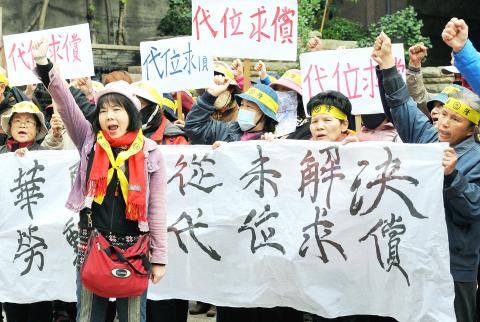
Photo: Chu Pei-hsiung, Taipei Times
To recover unpaid loans, the then-Council of Labor Affairs filed lawsuits in 2012 against loan recipients who had not repaid the debts, sparking anger among displaced workers, their supporters and activists, who have staged highly visible protests over the past year.
On March 7, the court ruled against the ministry, saying the loans were, in effect, compensation to the laid-off workers. It also found that the deadline for the government to pursue the matter — January 2006 — had long passed.
On Monday, the ministry said that it would not appeal the ruling, adding that it will drop similar cases against other former factory workers and that those who have repaid the loans will have their money returned.
Payments would also be returned to former workers who paid off the loans before 2012, Jiang said yesterday when answering questions from Chinese Nationalist Party (KMT) Legislator Lu Yu-ling (呂玉玲) at the Legislative Yuan.
Jiang said the decision to return the money to workers who were “more law-abiding” was made on Thursday night, on the principles of equality.
“Workers who were more law-abiding and returned the funds early should not have to suffer different treatment,” he said.
Meanwhile, Minister of Labor Pan Shih-wei (潘世偉) said the Ministry of Labor was leaning toward paying back the funds through the Employment Security Fund, but that the decision depends on the results of an Employment Security Fund management committee meeting.
Pan said that the ministry still considered the loans as such and not subrogation payments, meaning the government is not responsible for claims against the shuttered businesses.
Pan added that since the statute of limitations had expired, trying to reclaim the funds would be unlawful.
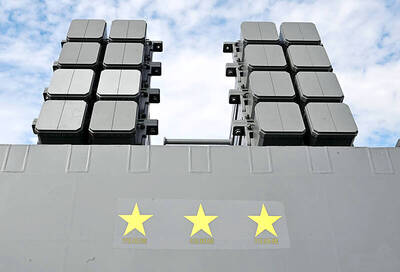
UPGRADE: The Kang Ding-class frigate is replacing its Chaparall missiles with Tien Chien II and Hua Yang VLS, which would provide it with long-range, 360° air defense Taiwan plans to produce 1,200 to 1,376 Hai Chien II missiles (海劍二, Sea Sword II) — also known as TC-2N — to serve as the standard air defense system of the navy’s surface combatant fleet, a source said yesterday. Last week, the Hai Chien II, the naval version of the Tien Kung II missile (天劍二, Sky Sword II), completed a live-fire test in waters off the National Chungshan Institute of Science and Technology’s Jiupeng facility (九鵬) in Pingtung County’s Manjhou Township (滿州). The MIM72 Chaparral and other dated air defense missiles that currently arm Taiwanese ships have inadequate range to combat Chinese

REASONS FOR TRAVEL: An assistant professor said that proposed amendments to penalize drivers if they used drugs overseas would not deter people from traveling People who operate a motor vehicle under the influence of marijuana would have their driver’s license revoked, even if they used the substance while overseas, the Ministry of Transportation and Communications said yesterday, citing proposed amendments to the Road Traffic Management and Penalty Act (道路交通管理處罰條例). The amendments would also authorize the government to revoke the licenses of people determined to have used Category 1 or Category 2 narcotics, even if they were not operating a vehicle while under the influence of drugs, as well as ban them from taking the license test for three years, the ministry said. People aged 18 or

HEAVY WEATHER: Typhoon Jangmi is due to crash straight into the Ryukyus as airlines look to shift flights to larger aircraft or cancel flights to Okinawa entirely Taiwan’s international air carriers announced flight adjustments over the weekend as Typhoon Jangmi is forecast to hit the Ryukyu Islands today and tomorrow. The Central Weather Administration (CWA) upgraded Jangmi from a tropical storm to a typhoon at 8am yesterday, with the eye located 580km south of Naha city. It was moving north at 19kph. Today, China Airlines’ CI-120, CI-121, CI-122 and CI-123 flights between Taoyuan and Naha, Okinawa, have been canceled as well as CI-132 and CI-133 between Kaohsiung and Naha. EVA Air’s BR-112, BR-113, BR-186 and BR-185 flights between Taoyuan and Naha are also canceled. Low-cost carrier Tigerair Taiwan canceled IT-230,
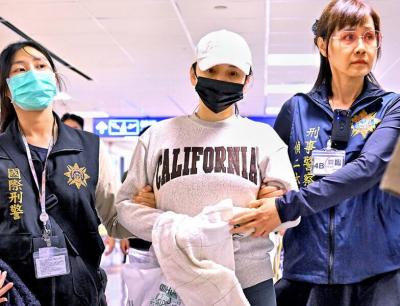
Johanne Liou (劉喬安), a Taiwanese woman who shot to unwanted fame during the Sunflower movement protests in 2014, returned to Taiwan last night after being deported from the US. She is to stand trial in Taiwan for charges involving embezzlement, fraud and drug crimes. The Criminal Investigation Bureau (CIB) said it took her into custody at Taiwan Taoyuan International Airport and would first question her before transferring her to the New Taipei District Prosecutors’ Office. She was arrested upon disembarking a flight from San Francisco that landed shortly before 7pm. Liou absconded to the US in 2019 after jumping bail


 RSS
RSS